Divorce and estate · Rent-stabilized four-family · Mount Morris Park, Harlem
A rent-stabilized brownstone in Harlem’s Mount Morris Park Historic District, owned by a couple divorced close to twenty years. The sale had every reason to stall or fall apart. It closed – eight months before New York’s 2019 rent law took a large share of the relative value out of buildings like it.
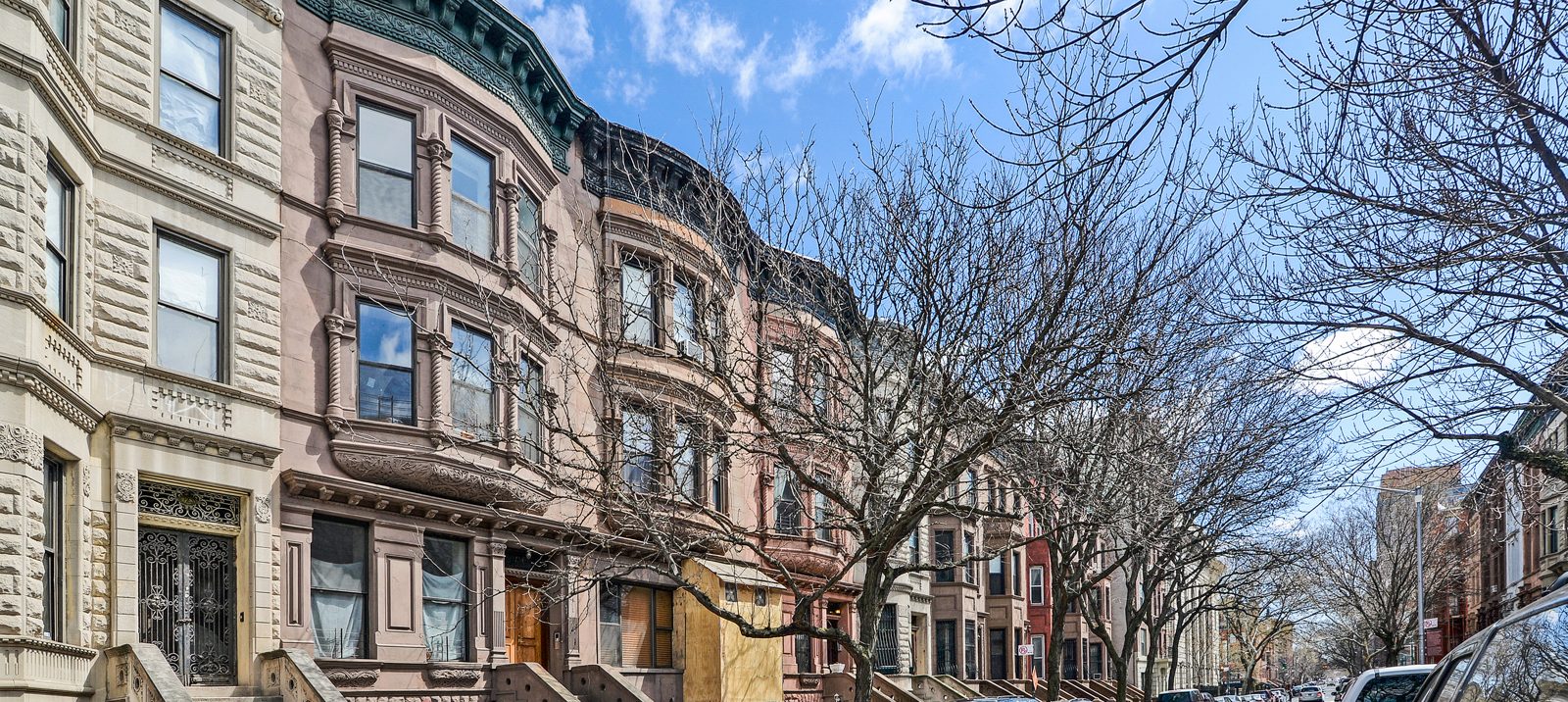
This case involved
The first hurdle was the building itself. Buyers of a four-family Harlem brownstone expect free-market apartments they can live in, re-rent or reconfigure. This one came with regulations that ran the other way, and that made finding the right buyer the central problem of the sale.
Why would someone shopping for a rent-stabilized building be looking for a four-family brownstone in Harlem’s Mount Morris Park?
Why would someone shopping for a Mount Morris Park brownstone expect, or want, one where any (let alone every) apartment is rent-stabilized?
They wouldn’t. Nobody would. That is just part of what made this an unusual and high-risk sale for my clients, even though they had no way of knowing it in advance; and it is part of what makes this a great case study.
In New York City, multifamily buildings sell to one of two types of buyers. Neither would be looking for or expecting this house and this situation.
Want enough units to boost their return, in equity and income: by rehabilitating, moving tenants into upgraded apartments, turning apartments over for the registration increases that came with a vacancy, combining units, and other strategies to take units out of stabilization altogether.
Stabilized buildings generally start at six or more units. Four is an anomaly, and generally too small.
Four apartments, all rent-stabilized, all occupied, under J-51 tax benefits that kept them that way.
A no-man’s land between the two.
Want to live in a unit, or bring the rents up to market. In this area, and with this kind of property, many also want to restructure it into fewer units or a single-family home.
Neither was possible.
A four-unit building was rent-stabilized here because its owners had chosen to use the J-51 program, which seemed attractive at the time but created challenges later. J-51 gave owners City property tax benefits for qualifying improvements, and in return the apartments in a building receiving them were rent-stabilized, even in a building too small to be stabilized otherwise. While the benefits ran, those apartments also couldn’t be taken out of stabilization through the deregulation routes owners of other buildings could use then, and this building’s benefits were scheduled to run until mid-2028, ten years after the sale.
So whatever a buyer was purchasing here, it wasn’t a path to market rents, and it had to be disclosed and priced that way from the start. Pitching it as a four-family with upside would have produced a contract that fell apart in due diligence.
The block is also in the Mount Morris Park Historic District (extended to this block in 2015), so exterior work needs the Landmarks Preservation Commission’s approval. Many brownstone buyers see that as a plus. For an investor, it is one more layer of rules.
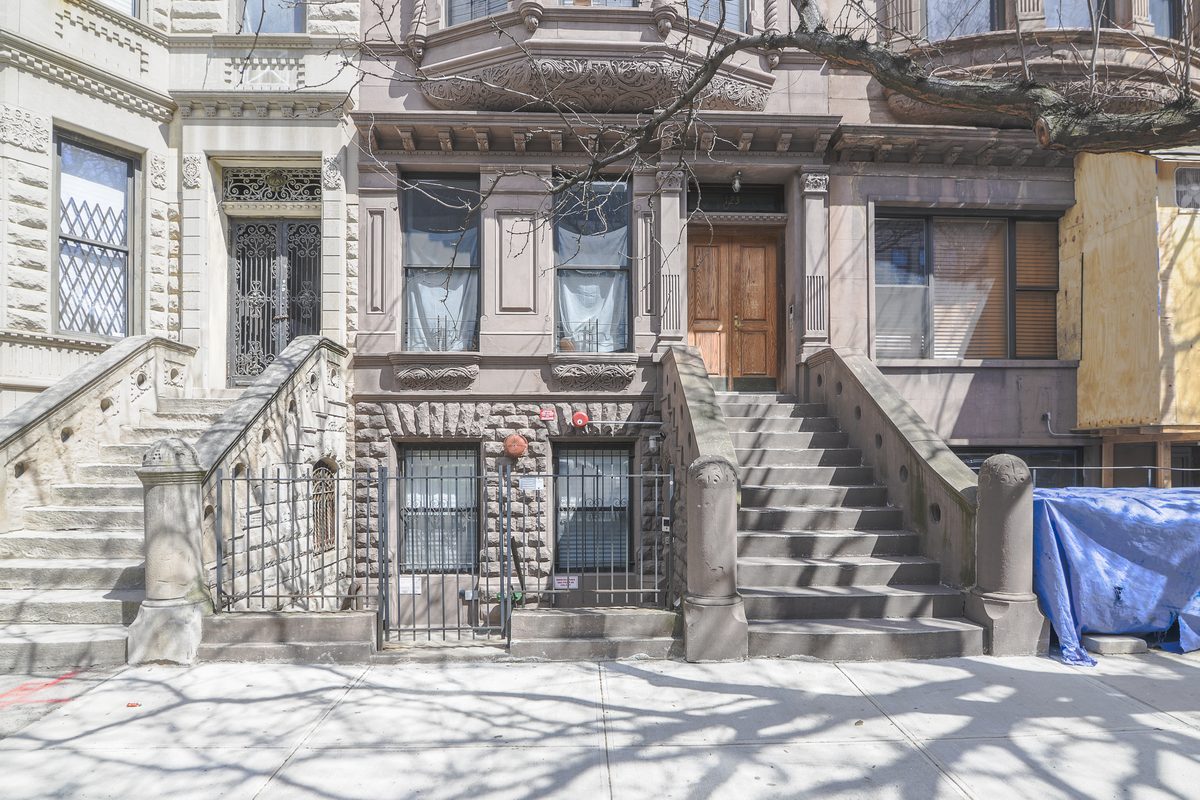
Floor by floor
From the building’s 2018 rent registration with New York State Homes and Community Renewal.
There is another enigma in a building like this. Buildings with five or more units are commercial property, financed and valued mainly on their income. Properties with one to four units are financed as residential property, and they’re usually appraised by comparing them with similar homes that have sold.
Five or more units
Commercial financing
Income: what the rents support after expenses.
Rent-stabilized typically, or stabilization expected
The stabilized-building buyer’s yardstick
One to four units
Residential financing
Comparable sales: what similar one-to-four family properties nearby sold for.
Free market expected
The one-to-four family buyer’s yardstick
A buyer of a stabilized building expects to buy on income, and regulated rents can put that number well below what the one-to-four family properties around it sell for. So the comparable sales said one thing and the income said another, and there were very few sales of anything like this building to settle the argument.
Bottom line is, I had to thread the needle: find the buyer for whom those constraints were acceptable, and hold the price without much to compare it to.
That buyer turned out to be the unicorn: an investor who already owned rent-stabilized buildings, including one very nearby, making the purchase benefit from economies of scale, convenience and simplified logistics.
As an ordinary one-to-four family, interest exceeded the $3.75 million asking price. Interest based on what we were actually selling topped out around $2.8 million. It went to contract, all cash, at more than $3.2 million.
The building was the easier part. When it came time to sell, every decision needed two owners who had been divorced for close to twenty years, while someone close to the building had interests of his own.
| Who | What it meant for the sale |
|---|---|
| Two sellers, divorced close to twenty years | When they divorced, they decided to keep the building, in part as something that might one day benefit their children. He had since remarried, and for years he ran the building, through the property manager, without her day-to-day involvement; I believe that is part of why she distrusted the manager. They still owned it together through an LLC, so when it came time to sell, both had to agree on who to hire, price, timing and terms. I kept both of them equally informed throughout, as is my normal practice in my divorce real estate specialty. |
| A property manager with a conflict of interest | The manager reportedly solicited the listing, and wanted to buy the building. The two owners, who disagreed about most things, agreed to hire me instead, and the manager kept working against the listing after they did. |
| A legal matter between the owners | A pre-existing matter between the two of them, unrelated to the sale itself, that would surface at the worst possible moment (Part 3). |
With a buyer found, the risks moved to the paperwork and the people: an obscure government document nobody had, and a dispute held back until the last minute.
The buyer’s side wanted the building’s J-51 Certificate of Eligibility before going to contract. The original had never reached the owners. It took a public records request and repeated follow-up before a copy turned up, and the contract was signed by both members of the LLC in August 2018.
Days before the closing, a pre-existing legal matter between the two owners was raised for the first time, to keep the proceeds from being disbursed. The title company would insure the sale only if every dollar went to the sellers’ LLC, so the closing was postponed while the attorneys worked out how.
In the end the sale completed (the deed transferred) and the sellers’ proceeds were held in escrow until their dispute could be resolved, which, as I understand it, took many months. None of that would have been necessary had they not deferred the sale for all those years.
The closing date turned out to matter more than anyone could have known, twice over.
He passed away very soon after the closing. Had that happened before it, his interest would have gone into an estate, essentially making unlikely business partners of his former wife and his current wife/widow/heir. They would have become co-owners of the property, and one can only imagine how that could have played out.
It avoided months of estate delays (assuming anyone would even have taken the steps to settle the estate promptly), unresolved legal matters between the former spouses that could have passed to his estate, and fights, stress and resentments over the inheritance. Any of those could easily have cost years, which would have run straight into number two.
Even with the law only close to being signed, or signed but not yet in effect, it would have had a massive cooling effect on the market, and on interest in an orphan property like this one.
This is the train no one in the transaction saw coming, and what it did to the market for buildings like this one.
On June 14, 2019, New York enacted the Housing Stability and Tenant Protection Act (Chapter 36 of the Laws of 2019). It was a ground-shifting reform. By capping what owners of rent-stabilized apartments could ever collect, and taking away most of the ways those apartments could leave regulation, it cut the income, and with it the relative value, of every building with stabilized units. Buyers pulled back almost immediately.
What changed on June 14, 2019
| For rent-stabilized apartments | Before | After | What it means for owners |
|---|---|---|---|
| Increase when an apartment turns overCh. 36, Part B | Up to 20% | None | The main way a stabilized rent caught up after a turnover is gone. |
| Leaving regulation (high rent or high income)Ch. 36, Part D | Possible | Repealed | Once stabilized, always stabilized, whatever the rent or the tenant’s income. |
| Building-wide improvements (MCIs), NYCCh. 36, Part K | Up to 6% a year, permanent | Slashed by two-thirds to only 2% a year, removed after 30 years | Far less reason to invest in the building itself. |
| Apartment improvements (IAIs)Ch. 36, Part K | A share of the cost added to the rent permanently, with no dollar cap | $15,000 per 15 years, at most 3, removed after 30 yearsAs in effect then; amended since. | Renovating an apartment between tenants often no longer pays for itself. |
| Preferential rent, at renewalCh. 36, Part E | Could rise to the legal rent | Stays for the tenancy | Give a tenant a break once and it lasts the whole tenancy, a disincentive to give breaks at all. (Some owners had used preferential rents to push registered rents up, but it was a tool that could benefit both sides.) |
| Overcharge claims look backCh. 36, Part F | 4 years | 6 years, with treble damages for willful overcharges | Six years of rent history open to challenge, including years before a buyer owned the building. |
| For every rental in New York State | After | What it means for owners | |
| Security deposits and rent paid in advanceGOL §7-108 | No more than one month’s rent | No more prepaid rent. Someone with money but damaged credit (after a foreclosure, say) could once prepay 6 to 12 months, which reduced the owner’s risk enough to say yes. | |
| Turning down applicants over eviction historyRPL §227-f | Not allowed (any past or pending landlord-tenant case in court) | Like telling a bank it can’t check, or turn down, a mortgage applicant who is in or has been through foreclosure on another loan. The owner’s risk is the same kind: tens to hundreds of thousands of dollars on the line. | |
| Application and screening feesRPL §238-a | Actual cost of the background/credit check or $20, whichever is less | Screening costs above that come out of the owner’s pocket. | |
| Late feesRPL §238-a | $50 or 5% of the rent, whichever is less, and only after 5 days | Little deterrent to paying late. | |
When the number of buyers willing to pay for an asset falls this sharply, that is lost equity for every owner of one, even where average prices hold up for a while because fewer owners are willing to sell. Here is what the City’s own sales records show for buildings with rent-stabilized apartments.
NYC Department of Finance sales data, as compiled by the NYC Rent Guidelines Board: 2020 Mortgage Survey presentation and 2026 Mortgage Survey Report (Appendices 6, 9 and 10; Staten Island excluded).
Owners took the State and City to court, arguing that the law, together with the rent stabilization system it made permanent, was an unconstitutional taking of their property. In one case, owners alleged their buildings had lost 20 to 40 percent of their value after the 2019 amendments. The federal courts dismissed those challenges, and the U.S. Supreme Court declined to hear them in 2023 and 2024, although Justice Clarence Thomas called the question “important and pressing” (74 Pinehurst LLC v. New York).
Law: Chapter 36 of the Laws of 2019 (S6458); NYS Homes and Community Renewal; HCR Fact Sheet 26 (IAI rules today); RPL §227-f; GOL §7-108; RPL §238-a.
To be clear, nobody in this transaction knew that law was coming – not the owners, not the buyer, not me. But what this case study shows is more important: a sale with every reason to stall or fall apart was positioned, marketed, negotiated and stewarded all the way to the closing table – timely and against all odds. A building that fit no buyer pool, two sellers with conflicts who likely didn’t agree on much, a property manager working against the listing, a missing government document and a last-minute dispute can easily take a year and a half. Had it slipped eight months, it would have run into the new law. Even approaching that time would have had a chilling effect as people began to become aware of the train coming down the track.
Years later, one of my two clients, the ex-wife (she had first come to me through a referral), came back to me for help with a property in another state, which I referred to a broker I trust there.
The lesson of this file for anyone keeping a property after a divorce.
When a divorcing couple holds on to a property, it can feel like the safe, smart or even creative choice, or simply one less stress for now. These two kept the building for close to twenty years, in part as something that might one day benefit their children.
Instead, they stayed tied together by a deed and a company, the sale still needed both of them, and a legal matter between them ended up holding their sale proceeds in escrow for many months. Because the sale had already closed, when he passed away the inheritance he left behind was no longer tied up in real estate – open to disputes among multiple interested parties, and complicated by any estate or administration proceedings that might have been required.
Sometimes holding on is the right answer, and your attorney will have good reasons for it. It’s prudent to weigh what it ties you to in the meantime, and who could end up with it (more on my divorce page).
He has been wonderful!! He is very knowledgeable in his field, resourceful and a great problem solver. … He was professional, kept us updated constantly, he was always available to talk, and made sure that all parties were on the same page at all times. I was amazed at how well he could keep his cool and be instrumental in destressing me!
The ex-wife and co-seller, writing to the friend who referred her, September 2018
Keeping a property after a divorce is a decision that stays live for years. When the parties finally sell, they need a broker both sides will accept and a process that holds up through their disagreements.
When ownership is split between people who no longer agree, or who could be replaced by their heirs, the closing date is the risk. Most everything else can be negotiated.
Regulated small buildings, mixed-use, properties with agreements or tax benefits attached: if yours falls between two buyer pools, pricing starts with which buyer is actually going to show up.
Consider me a resource on matters like this one, including ones where a listing isn’t likely yet: values, buyer pools, timing and what the market will actually bear. I’m also happy to help clients get oriented before they’ve retained counsel, and send them your way. More for attorneys

Diallo J. Stevens has been a licensed New York real estate broker since 2002, selling homes, multi-family and mixed-use buildings across New York City, Long Island and Westchester. He handles many sales tied to divorce, estates and court supervision.
Related: What New York’s 2019 rent law changed for owners of rent-stabilized buildings · Selling the marital home in a New York divorce · More case studies
Names of the parties are withheld. Not legal or tax advice.
I’d like your business. Let’s discuss your situation and see what makes sense.